ST HILDA'S SCHOOL
GOLD COAST


Mrs Belinda Gravel
Head of Faculty
Drama


Drama

Last week the Year 10 Drama students participated with much enthusiasm and bravery in a Circus Workshop with artists from Trix Circus. The students thoroughly enjoyed the challenge of acrobalance, creating dynamic feats of balance in human pyramids and other formations. The group also experimented with the much loved childhood past-time of the hula hoop, to create visually interesting feats of co-ordination, amidst much laughter. The workshop was an extension activity to the learning in the current unit of work exploring contemporary performance styles within the context of dreams. The students will take skills learnt in this workshop to performance in their upcoming Dream Theatre presentations.


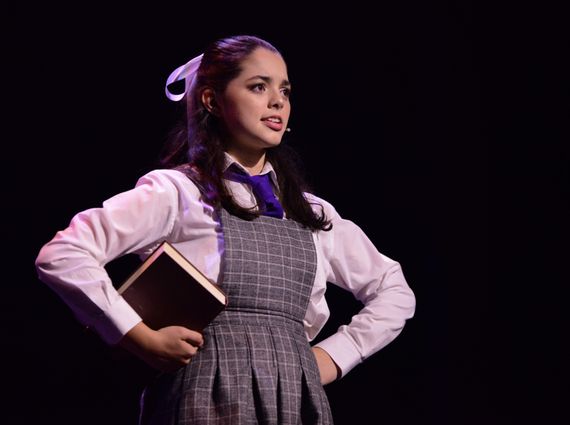
Drama provides a learning environment that promotes imagination, critical thinking, cultural engagement, communication, creativity and problem-solving. Drama provides a medium for exploration, social criticism, celebration and entertainment. Drama students participate in aesthetic learning in which the senses and emotions are engaged cognitively and affectively. Through this experiential mode, Drama offers a unique means of enquiry that empowers students. Learning in Drama is balanced between and integrated through practical, collaborative, individual and theoretical approaches.

The collaborative nature of Drama as an art form provides students with opportunities to learn to manage the processes of Drama and the Interpersonal and intrapersonal skills required to work effectively, both individually and in groups. Such skills, aligned with self-confidence are essential to give students, in a changing society, a critically active orientation necessary to play full part in their own culture, the culture of others and the world of work.


Drama is a compulsory subject in Years 7 and 8. Students may study Drama as an elective in Years 9 and 10 as well as in Years 11 and 12 as Drama is an OP eligible subject. Students may also undertake additional Drama and Performing Arts opportunities through our Extra-Curricular Speech and Drama Program (Trinity Guildhall) or through participation in the many co-curricular activities such as middle and Senior school plays, School musicals as well as cultural House activities.

Drama provides a learning environment that promotes imagination, critical thinking, cultural engagement, communication, creativity and problem-solving. Drama provides a medium for exploration, social criticism, celebration and entertainment. Drama students participate in aesthetic learning in which the senses and emotions are engaged cognitively and affectively. Through this experiential mode, Drama offers a unique means of enquiry that empowers students.

The collaborative nature of Drama as an art form provides students with opportunities to learn to manage the processes of Drama and the interpersonal and intrapersonal skills required to work effectively, both individually and in groups. Such skills, aligned with self confidence are essential to give students, in a changing society, a critically active orientation necessary to play a full part in their own culture, the culture of others and the world of work.


Expectations

Drama is a practical subject, engaging students in experiential and aesthetic learning experiences. However, Drama is an academic subject with a fundamental theoretical component. Students engage in the creative process through:

Working as an artist both collaboratively as well as individually to create, shape, present and critique Drama
  • Working independently in developing personal aesthetic
  • Manipulating a variety of technology, including the use of multi-media, lighting and sound
  • Developing creative and critical thinking skills
  • Developing skills in communication and presentation, nurturing self confidence and self expression
  • Participating actively in workshops, excursions to view live theatre, discussions, reflection as well as opportunities to perform for an  audience 

    Assessment:
    Students’ development in the three dimensions of Drama (forming, presenting, responding) are assessed in a variety of ways such as:
  • Performances
  • Written and practical assignments 


    Mrs Belinda Gravel

    Head of Faculty Drama


  • Copyright © St Hilda's School 2013

    The Corporation of the Synod of the Diocese of Brisbane trading as St Hilda's School - Registered CRICOS No 00510M

    Website by Hyperactive Designs